

How to Choose a PhD Title: A Comprehensive Guide
A PhD title is essentially the name of your research project, but it is far more than just a label. It is the first thing professors, peers, and other researchers see, and in a single glance, it should clearly communicate what your research paper and overall doctoral research are about. A well-defined PhD title highlights the relevance, focus, and academic value of your research.
A generic and confusing title can result in your research work being misunderstood, and on the other hand, if your title is very narrow or restrictive, it might not seem to be that important to your audience. In this blog, we explain how to choose a PhD title that aligns with your research objectives, methodology, and approval requirements.
Difference Between a PhD Topic, PhD Title, and Research Problem
| Aspect | PhD Topic | PhD Title | Research Problem |
| Definition | The broad academic area you’re interested in | The formal name of your study | The exact gap, issue or difficulty your research addresses |
| Purpose | To identify research interests | To communicate the essence of research | To justify the need for the study |
How to Align a PhD Title With Research Objectives
Clarify Objectives: Specify the objectives of your research and the type of questions being answered by the research.
Examine Key Concepts: Identify the salient factors or elements or define the subject matter coverage.
Use Precise Language: Avoid vague terms like study of, instead use action words like analyzing or predicting.
Include Methodology (if relevant): Mention your approach to make the title descriptive, e.g., Using Machine Learning to Predict Crop Yield.
Ensure Logical Flow: Make sure the title naturally reflects your objectives and research questions.
How to Identify Research Gaps for PhD Title Selection
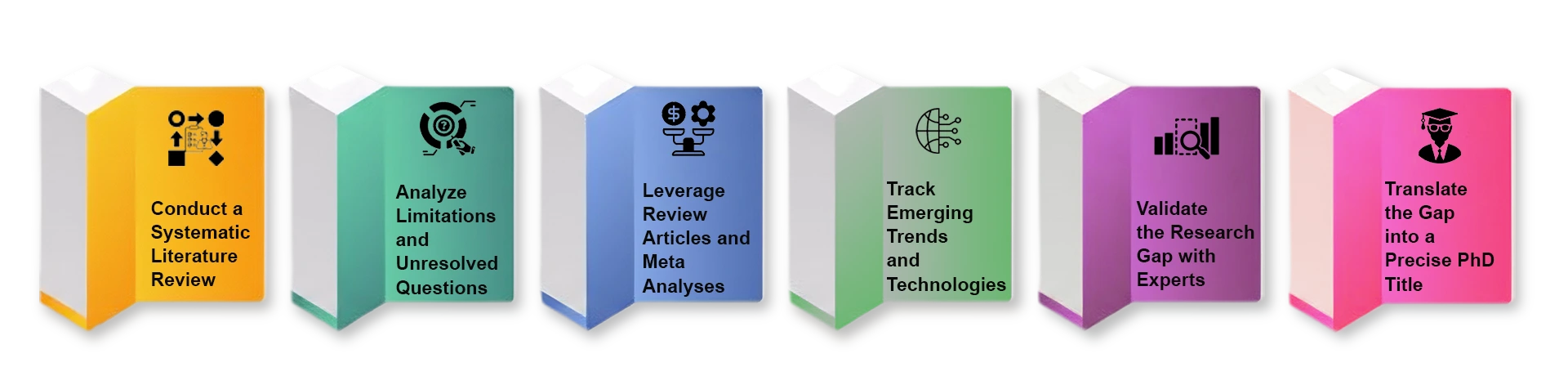
Conduct a Systematic Literature Review
Explore peer-reviewed journals, conference papers, and recent dissertations to understand what has already been studied, the dominant theories, and established methodologies—so you avoid redundancy.
Analyze Limitations and Unresolved Questions
Examine the “limitations” and “future research” sections of key papers to identify contradictions, unresolved problems, or underexplored areas that indicate genuine research gaps.
Leverage Review Articles and Meta-Analyses
Review papers synthesize existing findings, highlight inconsistencies, and explicitly point out areas where further research is needed—making them efficient gap-identification tools.
Track Emerging Trends and Technologies
Identify recent advancements, interdisciplinary overlaps, or societal and industry needs that have not yet been rigorously investigated in academic research.
Validate the Research Gap with Experts
Discuss the identified gap with your supervisor or subject experts to confirm its originality, relevance, feasibility, and suitability for a PhD-level study.
Translate the Gap into a Precise PhD Title
Refine the validated research gap into a clear, focused, and researchable title that reflects the problem, context, and scope of your study.
How to Ensure Originality and Publication Potential in a PhD Title
Unique Research Title Creation: Create a distinct title for research that separates it from all other research and helps build a distinct research identity among scholars.
-
Avoiding Redundant Language: Refrain from using generic language terms in your research by checking the previous literature that has not been covered in the previous point to avoid duplication of concepts.
-
Indexing and Discoverability: Optimize using academic search-friendly keywords to ensure high discoverability and citation rates across prominent academic indexing services globally.
-
Journal Scope Alignment: Align the study title with the journal scope goals for enhanced relevance for publication editor fit.
-
Impact and Originality: Improve the originality of publication titles for increased visibility of credibility and success of publication in high-impact-factor journals internationally.
University, Department, and Supervisor Guidelines for PhD Title Approval
Every university has a structured process for approving PhD titles, designed to ensure your research is clear, feasible, and academically valuable. While specific rules can vary, most institutions follow similar standards.
Common Requirements
-
Clarity: The title should be specific, easily understood, and not cluttered with technical jargon; however, technical vocabulary can be used if it correctly identifies areas of focus and objectives.
-
Scope: Research topics should be specified within the title and should be well within the time scope of three to five years. This is because research that is too broad or too narrow may not be possible.
-
Originality: The PhD title has to reflect originality in its title itself, signifying that it is work that will add new knowledge to the existing knowledge in the field.
-
Alignment: Your proposed topic for the research title needs to align with the department’s areas of expertise, research agendas, and resources to ensure adequate mentoring, direction, and resources during the span of the doctoral project.
-
Ethics: The title page has to indicate compliance with standards of practice, such as human/animal studies, privacy, or any ethical measures prescribed in a particular field of study.
How to Structure Keywords in a PhD Title for Academic Visibility
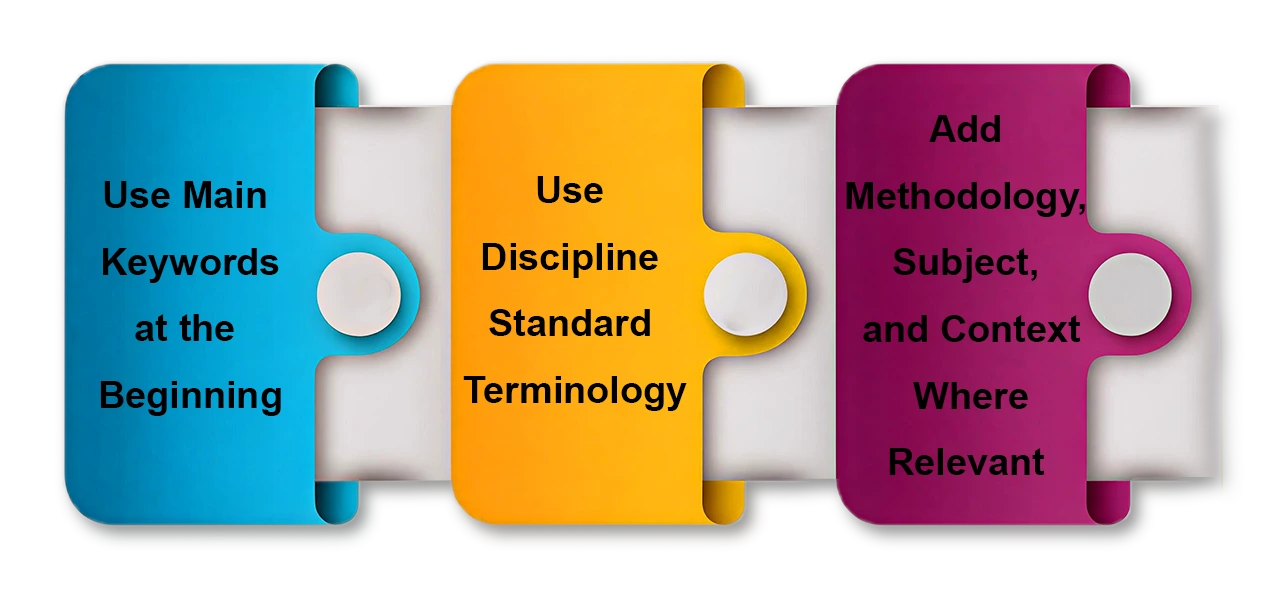
Your PhD title is like SEO for the academic world – it helps you and your work be found and cited so easily.
Best Practices for Keywords
-
Use Main Keywords at the Beginning: Begin the title of the document with the major subjects, topics, or variables so that they are recognizable from the very start, as early placement improves indexing priority and immediate clarity for reviewers and databases.
-
Use Discipline-Standard Terminology: Avoid the use of slang, informal vocabulary, or creative expressions. Use discipline-standard terms, as the adoption of technical vocabulary will elevate academic credibility.
-
Add Methodology, Subject, and Context Where Relevant: Include key details such as research method, population, organism, geographical scope, or time frame—only if they meaningfully narrow and clarify the study.
Discipline-Specific Requirements for Framing a PhD Title
The conventions for title development differ across different fields. Understanding the difference allows the researcher to be academically sound and assures smoother approval.
-
STEM: Should provide variables, procedures, and quantifiable results; there needs to be clarity regarding experimental or technical terms used.
-
Social Sciences: If possible, use concepts, population groups, regions, sociocultural contexts, or history to help detail the specificity that allows for the identification of relevance to a study.
-
Humanities: Addressing themes, texts, periods, or interpretive frameworks; clarity and scope are paramount to testing the contribution.
-
Arts or Interdisciplinary Studies: Titles may feature creative processes, themes analyzed, or cross-disciplinary links, but should remain clear and to the point.
Guidelines for Using PhD and Dr. Titles Professionally
Proper use of doctoral titles is essential for maintaining professional credibility and ensuring your achievements are recognized without appearing redundant or unfamiliar with academic norms.
1. The Golden Rule: Avoid Redundancy
Never use both the prefix (Dr.) and the suffix (Ph.D.) at the same time.
-
Correct: Dr. Alex Smith OR Alex Smith, Ph.D.
-
Incorrect: Dr. Alex Smith, Ph.D.
2. In Professional Correspondence
How you use your title in emails depends on the balance between authority and approachability:
-
Email Signatures: Use either "Dr. Alex Smith" or "Alex Smith, Ph.D." This establishes your credentials clearly.
-
Self-Introduction: In the body of an email, it is often more common to introduce yourself as "Alex Smith" and let your signature block communicate your title. Directing someone to call you "Dr. Smith" in an initial self-introduction can sometimes be perceived as overly formal.
3. In Publications and Research
-
Bylines: When publishing, follow the specific journal’s style guide. Most journals prefer your name alone in the byline (Alex Smith) and list your degree (Ph.D.) in the Author Biography or Affiliations section.
-
Consistency: If you use "Ph.D." in one publication, maintain that format across your CV and personal website to ensure search engines and databases index your work correctly.
4. Academic and Online Profiles
-
LinkedIn/Websites: "Alex Smith, Ph.D." is generally preferred for formal profiles as it specifies the exact nature of your degree.
-
Social Media: "Dr. Alex Smith" is common for handles or display names where space is limited.
5. Formats to Avoid
-
The "John Doe, Dr." format: Never put the title "Dr." after the name. Titles are prefixes and degrees are suffixes.
-
Using "Dr." in Social Contexts: Unless you are in a professional or academic setting, it is standard to omit the title to remain approachable.
Note on Professional Respect: Using these titles correctly preserves the dignity of your achievement while demonstrating your understanding of professional standards. When in doubt, "Name, Ph.D." is almost always the safest and most professional choice for written documents.
How to Check Feasibility of a PhD Title
Before finalizing, ask yourself whether your research is practical, realistic, and capable of being completed within a PhD.
-
Establish the availability of the information or the subjects and the necessary equipment.
-
Make sure procedures are possible with current skill levels and available expertise.
-
Assess if the scope of work in the study fits within the anticipated timeline and milestones.
-
Make adjustments in the title if it appears too ambitious, too specific, or simply not feasible for successful completion.
How to Refine and Finalize a PhD Title After Approval
Having the approval of your PhD title is just the first step. The more difficult part is perfecting it—to ensure it is understandable, specific, and of the highest quality. These are the steps to achieve it:
Gather feedback: Ask your bosses, colleagues, or other researchers. Sometimes, naive eyes will spot ambiguous words or phrases or omissions of meaning.
Test searchability: Use Google Scholar and academic databases. Ensure your title appears in search results and contains the relevant search keywords.
Polish the wording: Remove unnecessary words, use clearer terminology for variables, and use less technical vocabulary in favor of scientific terminology.
Ensure alignment: It’s important to be sure that the title of your dissertation or any other document you’re working on is in line with your objectives, methodology, and scope of study.
And yes, you might, in viewing this, doubt yourself, which is normal. Even after getting accepted, there could be times when modifying or perfecting the title is necessary. Modifications can result in a huge distinction in characterization, so there is no need to hesitate in this area.
Some Examples of Effective and Ineffective PhD Titles
Effective Titles:
Machine Learning Models for Predicting Air Quality Index in Delhi (2015–2025) → this is very exact, focused on the method applied, and highly searchable.
Post-Traumatic Growth in Earthquake Survivors: A Mixed-Methods Study in Nepal → clearly states the population and methodology applied with an explanation of the context of the research.
Ineffective Titles:
Studies in Machine Learning and Air Quality → vague, lacks specificity, and does not highlight research scope.
Effects of Trauma → too broad, unclear scope, and non-descriptive.
This is how you will refine your PhD title to make it clear, academically visible, and more likely to see successful publication.
Final Words
The selection of an appropriate title for a doctorate is an art and a strategic process. The effective title is a clear sign of the relevant topics you are researching and enables you to effectively convey this information to the supervisory team and other members in academia. This is in addition to blending in perfectly with the goals and aims of the department.
A PhD is more than just research; it's a reflection of originality and top-notch quality. Your work should make a meaningful, innovative contribution to your field. And don’t forget the title: a strategically crafted title can boost discoverability and increase your chances of getting published. If you need help in choosing a title for your research feel free to connect with our experts.
